
2 min read
Stretching — How to Increase Flexibility Safely
Stretching — how to increase your body's flexibility safely. Learn the types of stretching, the most common mistakes and the rules of an effective, safe practice.
Read more
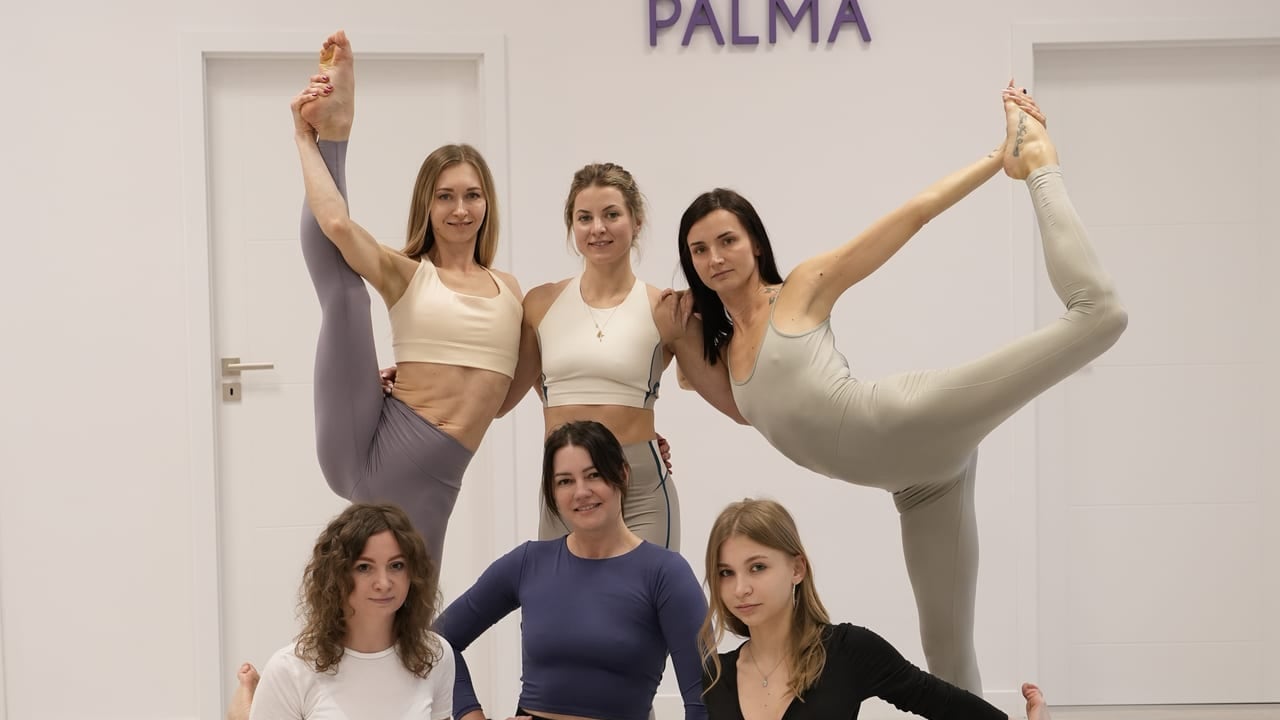
Stretching is calm, guided full-body flexibility work — no bouncing and no forcing through pain. At PALMA Studio in Wrocław's Krzyki district we treat it as the counterweight to hours spent at a desk: releasing what is tight and building range where it is missing. We work in small women-only groups, in socks, and you can follow every cue in English, not just Polish.
We start with a warm-up, because stretching cold muscles is the shortest route to a strain. A few minutes of calm, flowing movement prepares the muscles and joints for work — only then do we move into the actual positions. This order is non-negotiable and applies whatever the group's level.
The main part combines dynamic stretching — controlled movements through your range of motion — with static stretching, where you hold a position longer and work with the breath. We go through the body in turn: spine and chest, shoulders and neck, hips, the back line of the legs. If you spend your day at a desk, these are usually exactly the areas that complain the loudest.
One rule applies: stretching should be felt, never sharply painful. We do not bounce and we do not force our way into positions. The trainer offers an easier or deeper version and makes sure the breath stays calm — because that is what lets the muscles truly let go. We finish with a wind-down that leaves the body feeling lighter.
Live schedule from the booking system — refreshed every 15 minutes.
Single entries and passes can be bought online in the Fitssey system — via Przelewy24 (BLIK) or bank transfer; you can also pay in cash at the studio. Passes are valid for 30 days from the first visit.
A trial class costs 50 zł — a one-off entry, with no obligations.
See the price listRegular stretching increases the range of motion in your joints, releases tight muscles and improves posture. In practice that means less stiffness after long sitting, freer everyday movement and better recovery after other training. Flexibility is built over weeks of steady work, not in one evening — which is why consistency matters most.
The rule is simple: better shorter but more often than once in a while to the point of pain. Regular classes at the studio give you structure and technique corrections, and between them it is worth returning to a few positions on your own at home. The exact frequency is best agreed with the trainer — it depends on what your week looks like and whether you train anything else.
Stretching focuses on lengthening muscles and increasing range of motion — lots of positions held longer, with breath work. Mobility is about joint movement and control through the whole available range: not just "how far" but "how confidently". In our classes the two approaches blend: we work on flexibility, but always with control of the movement.
Yes. Stretching is not endurance training — there is no running, no jumping and no pace that leaves you gasping. We work at a calm rhythm, and every position can be done in an easier variant. It is one of the best ways to come back to movement while your fitness is still rebuilding.
That is one of the most common reasons women come to stretching. Hours in one position leave some muscles overloaded and others completely unused — hence the stiffness in the neck, shoulders and lower back. We deliberately aim the class at those areas. If you have sharp or persistent pain, though, see a doctor or physiotherapist first, and tell the trainer before class so she can choose safe variants — in English, Polish, Ukrainian or Russian, whichever suits you.
Absolutely. You do not need to be flexible to start stretching — it works exactly the other way round. We teach the technique from scratch, and the trainer sees every participant and matches the pace to the group's level. The easiest way to find out is a trial class.
Come in, meet the studio and your trainer, get a feel for the atmosphere — a trial class costs 50 zł and commits you to nothing. Booking online in Fitssey takes a moment.
Book a classA trial class costs 50 zł and comes with no obligation. You can cancel a booking without losing the entry up to 6 hours before the class starts.